

Improving safety together
Working with ATC
A safe airways system relies on pilots and controllers working together safely and effectively. Air Traffic Control (ATC) are always here to help. Help us to support you by understanding how ATC works, and what you can do to contribute to effectively working together.
Communication with ATC
Effective communication relies on standard phraseology, RTF discipline, and attentive listening. Avoid non-standard calls and incomplete readbacks to ensure ATC understands your intentions and confirm your clearance. Learn about the components requiring readbacks, including route clearances, holding instructions, taxi clearances, approach clearances, and more.
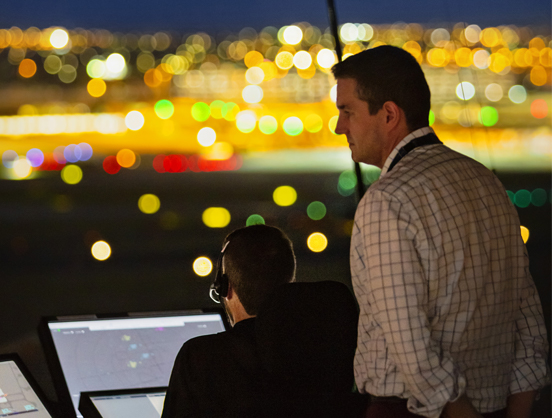
ATC can see the big picture
Air traffic controllers provide valuable perspective about current and emerging risks. This can inform airspace users in certain areas of certain operations to be mindful of and provide specific operational advice about areas where risks commonly occur.
For more information on current and emerging risk around the Gold Coast Region, visit The View from the Gold Coast Tower.
ATC are there to help
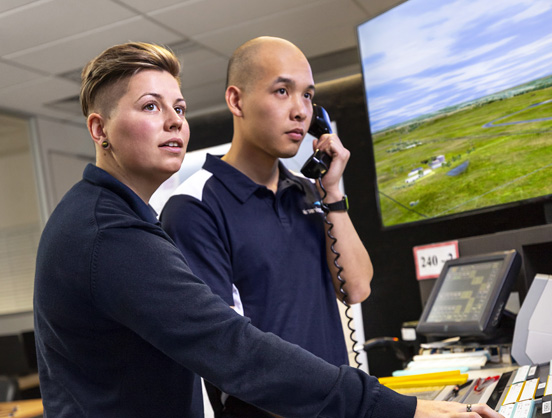
ATC manages the safe and orderly flow of aircraft into, out of and around Australian airspace. Controllers do this in a number of ways and can provide a variety of support to airspace users.
ATC are there:
- to provide operational information
- to provide assistance to aircraft that need it
- to use their training to deal with a range of situations
- to ensure pilots are provided every assistance possible if in difficulty
Some of the component's ATC can support with are:
- Maps
- First and last light
- Operational documents e.g., ERSA, NOTAMS
- Contacting other aircraft for assistance
- Contacting outside agencies
For more information, visit How Air Traffic Control Works.
For more information on how ATC can support when confronted with adverse weather conditions, watch Weather and Forecasting Part 1 - Operational Overview here.
Airservices Australia
Communication with ATC
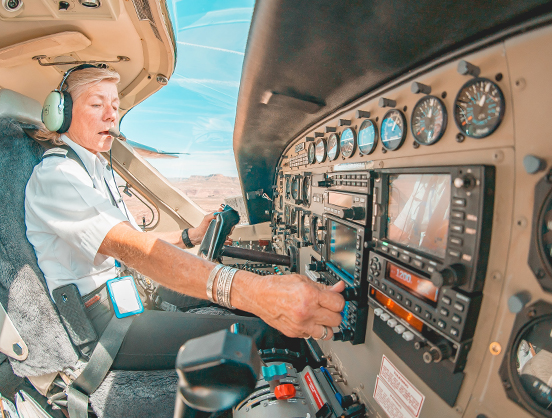
Communication with ATC involves exchanging safety-critical information between pilots and air traffic controllers. To enable controllers to do this, it is essential that pilots maintain a listening watch on their radio at all times by ensuring:
- that they are on the correct frequency
- their radio is working
- the volume is turned up.
Radiotelephony (RTF) discipline, including use of correct phraseology and readbacks, not over-transmitting other stations and maintaining a good listening watch also make for safe and effective communication.
Phraseology and readbacks
Most standard radio transmissions and readbacks are in a format that enables both the pilot and the air traffic controller to relay required information efficiently and effectively. The use of non-standard radio calls or readbacks affects the ability of ATC to understand your intentions and confirm that you have understood your clearance. If your readback is incorrect or incomplete, ATC will need to confirm your understanding: leading to additional conversation, complexity, workload and frequency congestions. This may also impact you or other aircraft by increasing the chances of incorrect information being passed or received.
AIP GEN 3.4 12, 5.4 details pilot radio call and readback requirements.
Standard components of an ATC transmission that require readback
 |
the ATC route clearance in its entirety, and any amendments |  |
any approach clearance |
 |
en route holding instructions |  |
assigned runway altimeter settings directed to specific aircraft, radio and navigation aid frequency instructions |
 |
any route and holding point specified in a taxi clearance |  |
SSR codes, data link logon codes |
 |
any clearances, conditional clearances or instructions to hold short of, enter, land on, line up on, wait on, take off from, cross, taxi or backtrack on any runway |  |
level instructions, direction of turn, heading and speed instructions |
For more information, read the Communication With Air Traffic Control Fact Sheet
Using NAIPS for flight planning
The National Aeronautical Information Processing Systems (NAIPS) Internet Service (NIS) is a multi-function, computerised, aeronautical information system. It processes and stores meteorological and NOTAM information as well as enabling the provision of briefing products and services to pilots and the Australian Air Traffic Control platform.
For more information, please view Flight planning - Part 1 - NOTAMS, Met and Airfield Data Webinar.
For more details on how to use NAIPS to access NOTAMS, visit the range of short videos below.
- Lodge A VFR Flight Notification
- Access Meteorological and NOTAM Information For Flight Planning Purposes
- Access and Understand Restricted Area Briefing Information
- Lodge and Cancel A VFR SARTIME
- Create a Specific Pre-Flight Information Briefing (SPFIB).
You can access more detailed information on using NIS is contained in the NAIPS Internet Service User Manual, on the Documents and Downloads section of the NAIPS homepage.

Estimating your position
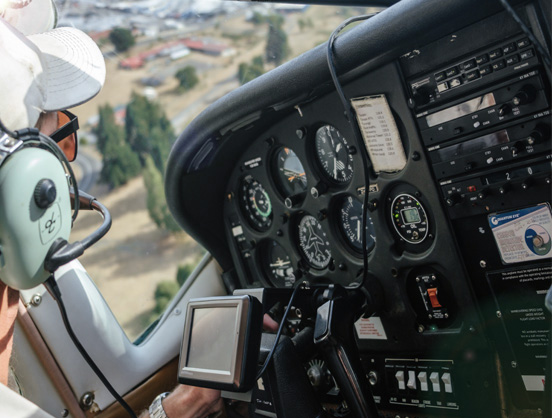
Air traffic controllers rely on accurate pilot estimates to apply time-based separation standards. Position estimate discrepancies can represent a safety issue as they can impact on separation, coordination, accurate traffic assessments and SARWATCH.
Pilots must advise air traffic control if estimates change by more than two minutes.
To help remind pilots in your organisation of the importance of maintaining accurate estimates please print and display the Pilot Estimates Poster.
For more information or to obtain a copy of the poster email safety.promotions@airservicesaustralia.com
Traffic Information Broadcast By Aircraft (TIBA)
When air traffic services (ATS) are temporarily not available, your familiarity with TIBA procedures can help us to continue to manage Australian airspace safely. Airservices uses NOTAM to notify airspace users when ATS is temporarily not available, with as much notice as possible. In Australia, when ATS is temporarily not available in Class A, C, D or E Area or TMA airspace, the enactment of TIBA procedures is accompanied by the activation of a Temporary Restricted Area (TRA). If you need to operate in airspace that is subject to TIBA and/or TRA due ATS temporarily not available, the NOTAM for the particular location will advise which radio frequency(s) TIBA procedures must be applied on.
For further information:
- please visit the Traffic Information Broadcast by Aircraft (TIBA) Fact Sheet
- to download the printable poster, please see the TIBAs and TRAs A3 poster


Flight following
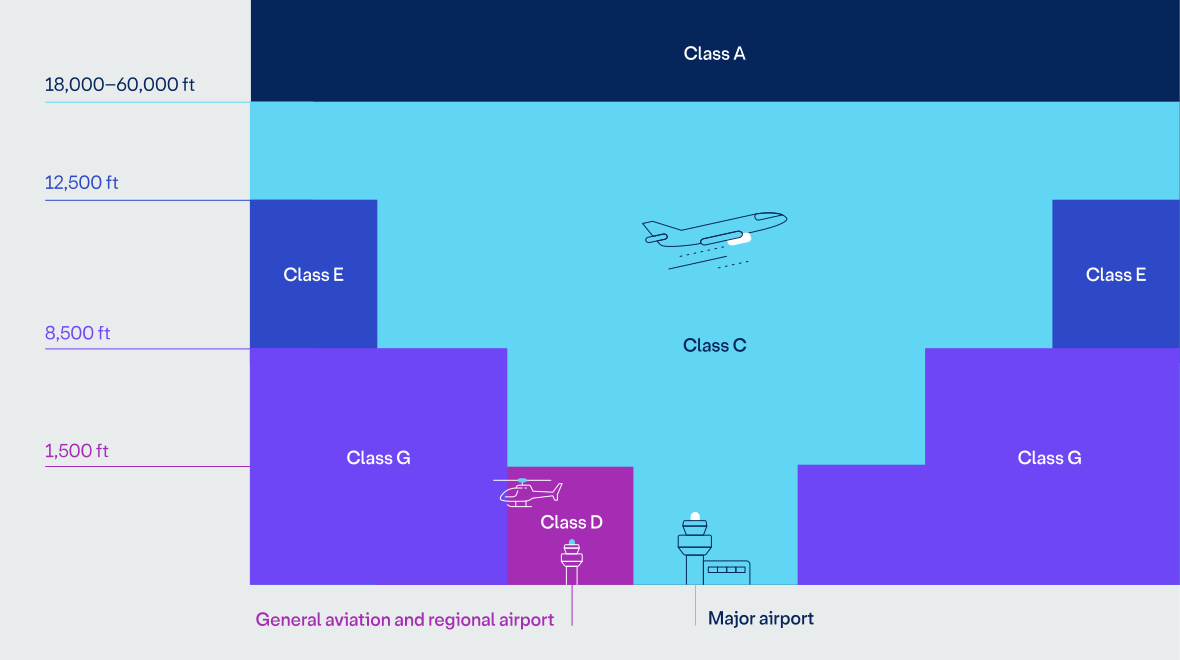
Flight following is a free ongoing Surveillance Information Service (SIS) available to VFR flights in Class E and G airspace. This service is provided to improve situational awareness and assist pilots in avoiding collisions with other aircraft. It is available on request, but always subject to air traffic services (ATS) workload.
To find out more about the flight following service, visit the Flight Following Fact Sheet.
Operating in Class D Airspace
Whether operating at a Metropolitan Class D (ex-GAAP) or a Regional Class D aerodrome, the principles of operating in Class D airspace are the same. However, there are several areas of confusion raised by pilots, including:
- the level of separation provided
- the requirement to follow ATC instructions and clearances
- the abbreviated clearance process
- the requirement to give a Departure Report
- aircraft manoeuvring and ACAS.
For further information, visit the Operating in Class D Airspace Fact Sheet .
Operating at metropolitan Class D airports can pose a range of additional considerations for pilots, due to their complex aerodrome layouts and diverse traffic mix combined with individual pilot experience.
For further information including:
- flying at specific Class D aerodromes,
- tips to avoid runway incursions
- contributing factors to runway incursions
In-flight information—pilot responsibilities
Pilots are responsible for obtaining information necessary to make operational decisions. Obtaining information pre-flight and in-flight to make operational decisions is important to the conduct of safe flight. It is important to understand what responsibilities the pilot has to obtain information pre-flight, what information needs to be requested in-flight and what is given automatically by air traffic control.
For further information, visit the Pilot responsibilities for obtaining information in-flight fact sheet.
Deviating from standard arrival routes (STARs)
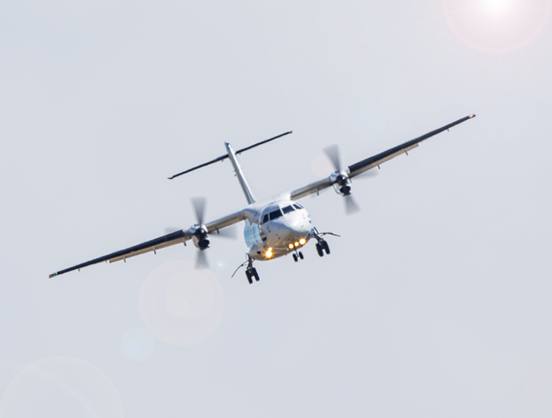
Vertical or lateral deviation from Standard Arrival Routes (STARs) can affect the safety and efficiency of a flight.
For further information on some common areas of confusion regarding the requirements to follow STAR tracks and heights, visit the STARs fact sheet.
Download
Pilot resources
View other resources for pilots.
Safety publications
Including Safety Bulletins which provide important advice on emerging safety issues.
Related links
Pilot-Controller Communications (OGHFA BN) | SKYbrary
Further reading
Videos & podcasts
Readback Hearback | SKYbrary
Human Factors for Pilots | CASA